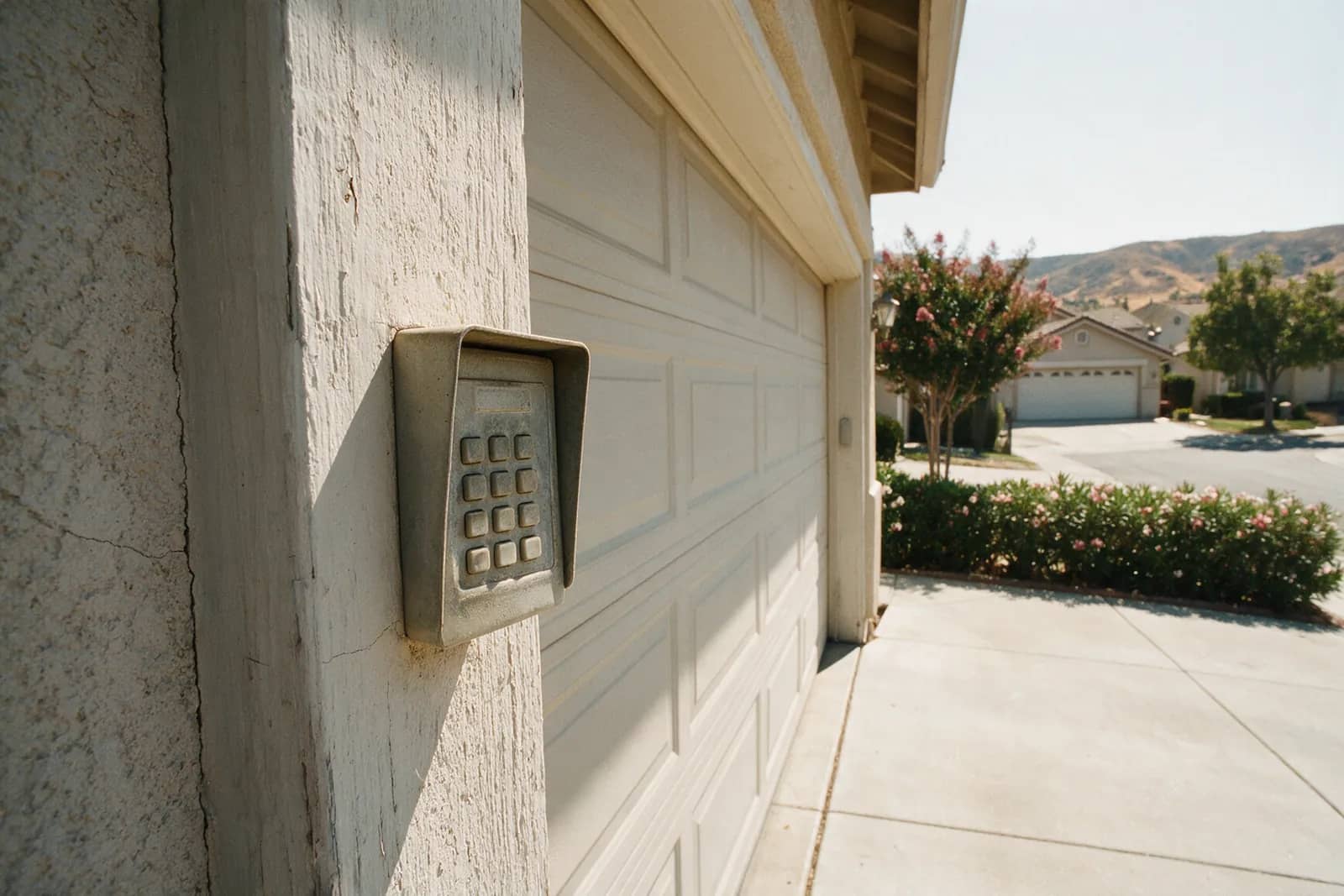
Two different keypads, two different answers
Before anything else, work out which keypad you have, because people call both of them the garage keypad and they are not the same device. One is the little pad screwed to the trim beside the overhead door. It is a radio transmitter. You type a code, it sends a signal to the opener, the opener runs the door. There is no lock in it anywhere.
The other is a keypad deadbolt in an actual door: the service door onto the side yard, the front door, the door from the garage into the house. That one has a bolt, a motor and a key override cylinder underneath. It is a lock, and it is our work.
The distinction matters for who you call. If the pad by the roll-up has stopped talking to the opener and a fresh battery does not fix it, the fault is in the opener and its receiver, and that is a garage door company. We do not work on opener motors. We do work on every keypad that has a bolt behind it, and we can get you into the house through a keyed door tonight either way.
Heat is the first suspect, and it is usually right
A keypad on a west-facing wall in Livermore in July sits in full sun through afternoons over a hundred degrees. Alkaline cells hate that. They lose capacity fast, and a set that would have lasted a year indoors gives out in a summer. Worse, they leak. A crust of white powder on the contacts is the commonest thing found behind a dead keypad cover, and once it is there, new batteries alone will not bring the pad back until the contacts are scraped clean.
The pattern people describe is specific and it is a giveaway. The pad works at seven in the morning, refuses at four in the afternoon, works again after dark. That is a battery sagging under heat, not a broken lock. Change it before you call anyone.
Use lithium AAs in an outdoor keypad rather than alkaline. They cost more, they hold voltage across a much wider temperature range, and they do not weep into the housing. And take the batteries out of the drawer they have been sitting in since last year: a partly used set in a hot pad is the same problem again in six weeks.
The rubber, the sun and the sprinkler
Look at the four digits of your code. On a pad that has been in use for a few years they are shiny, worn smooth, or slightly sunken compared with the other buttons. That tells anyone standing at the door exactly which four numbers matter, which cuts the guessing down to a couple of dozen combinations. It is a reason to change a code every so often even when nothing is wrong.
It is also a wear problem. UV hardens the membrane, the button domes crack, and water finds its way in behind the faceplate. On the side of a house, the usual water is not rain. It is a sprinkler head that got knocked in a direction nobody noticed, watering the keypad four mornings a week from April onward. Walk the yard while the system runs once a year and you will find it.
A pad with cracked buttons or corrosion inside is replaced rather than nursed. On a door lock, that is $179 to $449 fitted for a keypad deadbolt, with the visit and the parts inside the figure and a code you set yourself before we leave.
The bolt that is fighting the door
Here is the one that gets misdiagnosed most often on keypad deadbolts. If the batteries in your lock die every few weeks, the batteries are not the problem. The motor is straining. Every single time it throws or retracts, the bolt is grinding against a strike it does not line up with, and that draws several times the current it should.
Livermore summers do this on their own. A door swells in the heat, sits a little differently in the frame, and by August the bolt is dragging on the lip of the strike plate. In winter it goes back and everybody forgets. On the service door into the garage, where the frame takes sun on one side and shade on the other, it is nearly seasonal.
Test it with the door open. Turn the lock and watch the bolt run in and out with nothing to hit; then close the door and do it again. If the second one is slower, louder or needs the door pulled toward you, the strike wants adjusting, not a battery. That adjustment is small work and it is often the whole fix.
The code nobody ever reset
The last cause is not a fault at all. Somebody changed the code, or the code was never yours to begin with. Builder keypads on the newer south-side houses are frequently handed over on the number the installer set, and the same number sat on twenty houses in the same tract.
The other version happens after a power cut. The pad by the roll-up loses its pairing with the opener and has to be taught the code again, which is a short sequence in the manual involving a button on the opener unit. It takes about five minutes, it costs nothing, and it is a job for you and a stepladder rather than a locksmith.
On a keypad deadbolt, deleting old user codes and setting a new one is also yours to do from the keypad menu, and it is worth doing on a schedule rather than after a reason. If you have lost the manual, the model number is on a sticker under the battery cover.
The checks in order, and the figures
Run them in this sequence and you will solve most of these without a visit. Fresh lithium batteries from a sealed package. Look for white crust on the contacts and clean it. Try the code slowly, one digit at a time, because a worn membrane misses fast presses. Test the bolt with the door open and again closed. Then test a remote or the key override, which tells you whether the fault is the pad or everything behind it.
If you are standing outside right now and none of that helps, a house lockout is $129 to $225. That covers opening a keyed door without damage and cutting a key if you do not have one. The $89 service call is counted inside it, and so is the $45 between 8pm and midnight or the $80 between midnight and 7am. Calls are answered 24/7 and the figure is said on the call.
If the pad is finished, a keypad deadbolt fitted is $179 to $449 and an ordinary deadbolt is $118 to $299. Either way you should leave that visit holding a key or a code you chose, and if the failure turns out to be the overhead door rather than a lock, we will say so and get you in through another door rather than sell you something we do not do.
Quick answers
My keypad works in the morning and not in the afternoon. Why?+
That is almost always a battery losing voltage in the heat. A pad in full sun on a hundred-degree Livermore afternoon can read fine at seven and refuse at four. Fit fresh lithium cells rather than alkaline and check the contacts for leakage crust while the cover is off.
I put new batteries in my keypad deadbolt and they died in a month. What is wrong?+
The bolt is fighting the strike. Test it with the door open, then closed; if the closed test is slower or louder, the door has moved in its frame and the motor is straining every cycle. Adjusting the strike fixes both the drain and the door.
Do you work on the keypad next to the big garage door?+
Only up to a point. Its battery and its code are five-minute jobs you can do yourself with the manual. If the opener will not learn it, the fault is in the opener, which is a garage door company and not a locksmith. Keypads with a bolt behind them are ours.
How often should the code be changed?+
Once a year is a sensible habit, and immediately after a contractor, a house sale or a house sitter. The worn shine on four buttons narrows a code down to a couple of dozen tries, so a code that has not moved in five years is doing less than you think.
Need it handled rather than read about?
(925) 493-8551